Software and operational portals
Give your team a shared place to complete a task, see its status and control access.
Prepare my project briefThe practical outcome
A usable first workflow with defined roles, data and acceptance tests, plus documentation for handover.
We scope web applications, portals and dashboards around the work a user must complete. A first phase may organize requests, documents or approvals for a small set of roles. We compare an existing product with custom development, identify the data owner and test access and recovery alongside the main workflow.
One place to see and do the work.
A request becomes a shared record with a status, an owner and access matched to each role.
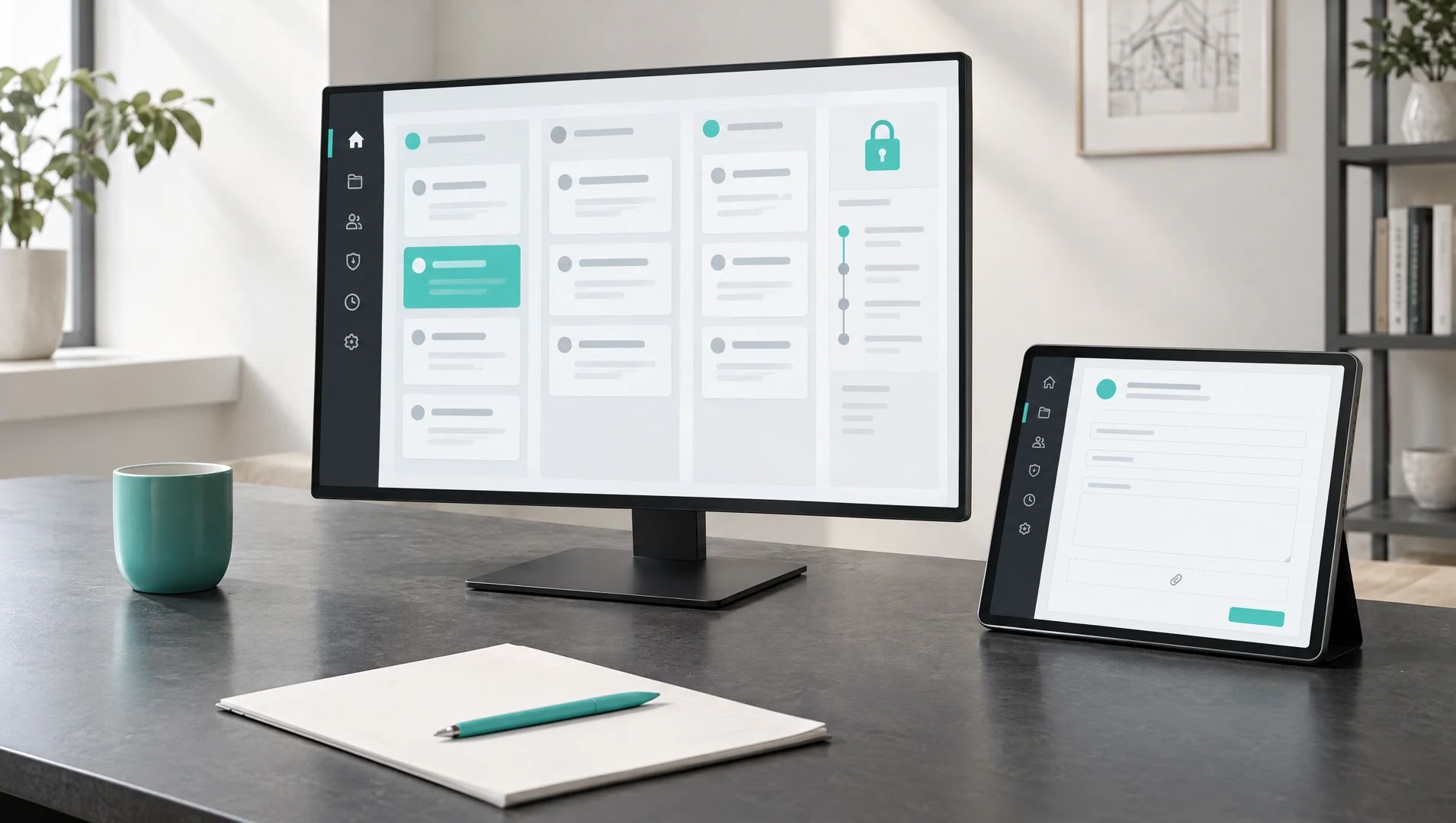 From input to outcome
Original concept filmAn explanation of the service. Not a client case study.
Give a team one place to receive a request, see its owner and follow its status.
Input
Capture only the information needed for the agreed task.
Decision
Let authorized users see the owner, required information and next action.
Result
Complete the request and retain its agreed history and result.
Bring the request and relevant information into a role controlled review screen.
Input
Bring together the request and the information the reviewer needs.
Decision
Check the role before approving, returning or rejecting an item.
Result
Show the outcome, responsible role and next step in the workflow.
Connect a record with the authorized documents people need to complete the task.
Input
Identify the source of truth, document owner and allowed formats.
Decision
Match document access and changes to the agreed user roles.
Result
Test retrieval, access denial and the documented recovery path.
What the work can include
- A scoped web application or portal for the agreed user task
- Role and data model with documented access rules
- Tests for the main flow, invalid inputs, permissions and recovery
- Deployment, access inventory, operating notes and team training
Boundaries to agree on
- An initial portal does not imply a complete ERP, native mobile app or universal migration.
- Ownership, reusable components and third party licenses are identified in the proposal.
- Maintenance and new features have separate coverage, capacity and approval.
A clear path through the work.
Our approachReview screens and roles before building the agreed phase.
Verify real tasks and hand over the documented system.
Make the direction tangible.
Before your next step
Useful answers. Clear expectations.
Understand the starting point, the review and the scope before sharing a request.
What should a first portal contain?
A useful first phase centers on one task, a small set of roles and the records needed to complete it. Define where work starts, how status changes and what counts as completion. Additional modules follow evidence from use and a separate scope.
How do we choose between an existing product and custom software?
Compare fit for the task, user access, export options, integration limits and total operating responsibility. An existing product may be faster to adopt. Custom software may fit a specific workflow better but requires delivery, maintenance and a clear owner.
Can different people see different records?
Yes, when roles and record ownership are part of the agreed design. Access must be enforced where data is stored or served, not only hidden on a screen. We test unauthorized reads and writes as well as normal user tasks.
Can we move data from spreadsheets or another system?
A migration can be scoped after reviewing the available exports, field definitions, duplicates and record counts. We agree on mapping, validation and a rollback or recovery plan. A portal project does not include every historical record by default.
Will the application work on phones?
We identify target devices and browser support in the scope and can design a responsive web experience. Offline operation, device hardware features and native app store distribution are separate requirements. Testing must include the devices your users actually rely on.
How do we decide the software is ready?
Agree on acceptance tasks before building. A user should complete the main workflow using representative data, including missing fields, denied access and a recoverable error. Completion is judged against that scope; a polished screen alone does not demonstrate a usable system.
What should handover include?
The agreed handover names account owners, access, source or delivered assets, dependencies, operating instructions and recovery arrangements. Training should let the team complete normal tasks without developer assistance. Third party rights and reusable components remain subject to their stated terms.
Is Tech offering a standard subscription product?
This catalog offers scoped services. Ongoing maintenance may be agreed for a delivered system. A shared subscription product is a future possibility only after repeated needs, usage, costs and willingness to pay are validated; it is not presented here as an available product.
Your next moveStart with the work.
Start with the work.
Make the next step clear.
Describe what your team needs to improve. Explore a direction and prepare a brief you can review.
Prepare my project briefExploring does not send a request. You choose when to share it.