Automation and applied AI
Connect a recurring workflow, make exceptions visible and review AI before sensitive actions.
Prepare my project briefThe practical outcome
A bounded workflow with clear status, review points, logs and a way to pause or recover.
Useful starting points include routing an intake request, extracting a small set of fields, preparing a draft and answering from approved knowledge. We define which steps follow rules, where AI can assist and where a person decides. Provider access, data quality and a safe manual fallback shape the implementation.
Move the work. Keep the review.
An incoming request follows explicit rules, reaches a review point and ends with a visible next action.
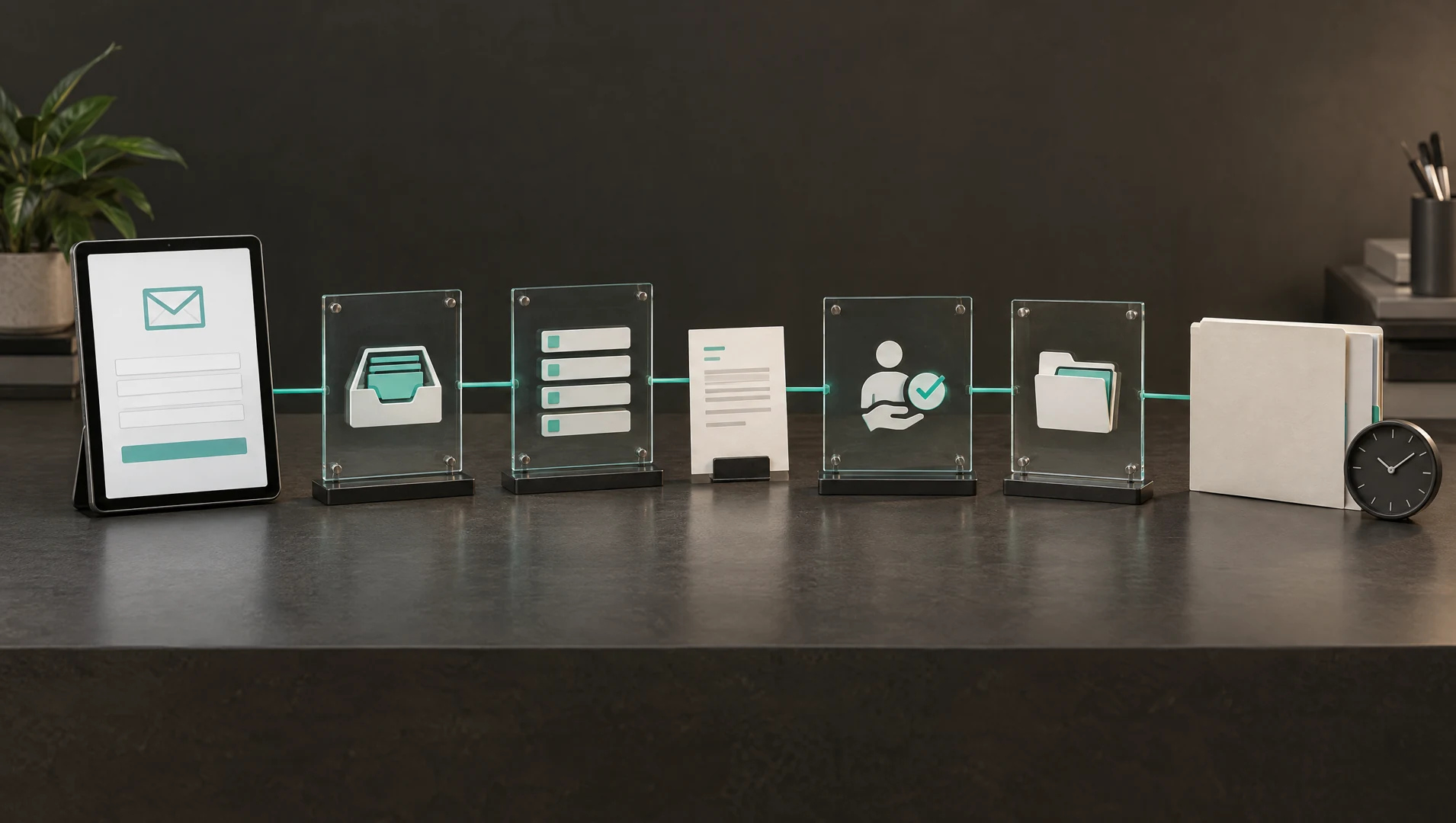 From input to outcome
Original concept filmAn explanation of the service. Not a client case study.
Organize an incoming request without hiding missing information or exceptions.
Input
Receive the agreed fields through an authorized channel.
Decision
Assign an owner using agreed rules, or return incomplete cases for review.
Result
Record the status and the person responsible for what follows.
Use a bounded set of approved documents to prepare an answer with a source people can inspect.
Input
A question and approved documents define what the response can cover.
Decision
Find a relevant approved source and identify when the information is insufficient.
Result
Present the source, limits and a useful next question for review.
Prepare a draft from authorized information and leave sending or committing to a person.
Input
Use the fields and source material approved for this specific task.
Decision
Create a draft and show the reviewer where judgment is needed.
Result
The authorized person decides whether to edit, approve or stop.
What the work can include
- Workflow connecting the systems agreed in the scope
- Rules for inputs, permissions, human approval and exceptions
- Evaluation examples for AI output and provider failure
- Operating guide, training and agreed usage controls
Boundaries to agree on
- AI can be wrong; it does not provide medical, legal or financial advice.
- Access, provider limits and external consumption are checked and scoped separately.
- New workflows, broad migrations and unattended sensitive decisions require separate review.
A clear path through the work.
Our approachBuild a small flow with review and exception handling.
Test representative cases before activating agreed actions.
Make the direction tangible.
Internal demonstration
Workflow planner
An internal planning demo: name a request and move it through illustrative receipt, review and delivery states. You control each transition. It does not connect to accounts or execute external actions.
Internal demonstrationKnowledge source map
An internal search demo: enter a topic and inspect matching approved public sources. Open the original pages to review the information. This local search does not generate an AI answer or read private documents.
Automation and AIPrepare knowledge an assistant can cite
Give each source an owner, audience, approval date and a clear path for corrections.
Automation and AIPlace human review before consequential actions
Separate a generated suggestion from permission to send, update or make a commitment.
Before your next step
Useful answers. Clear expectations.
Understand the starting point, the review and the scope before sharing a request.
Which task is a good first automation?
Choose a frequent task with a clear input, a known owner and a result that can be checked. Intake routing, reminders and draft preparation are possible examples. A task with unclear decisions or many unresolved exceptions may need process work first.
Does every automation need AI?
No. Rules are often more suitable for fixed fields, routing, duplicate checks and approvals. AI can assist when language or variable documents require interpretation. We should use it only where representative examples show that the benefit justifies review and cost.
Can an assistant answer from our documents?
It can be scoped to approved documents with identifiable owners and sources. We define who may see each source, how updates are approved and what happens when an answer is missing. Source citations help review; they do not guarantee that every generated statement is correct.
Can AI send messages or change records automatically?
Only actions explicitly authorized for the workflow should be available. We define permissions, validation and approval before activation. For sensitive or consequential steps, a person reviews the output before it is sent or applied; a generated suggestion is not authorization.
Can you connect any two business tools?
We must check APIs, account plans, permissions, data formats and provider limits. Some tools offer a supported connection; others may require exports or a manual step. A feasible integration is confirmed during scoping, not assumed from the names of the products.
What happens when a provider or workflow fails?
We design an explicit failure state, logs and a manual fallback for the agreed process. Retrying a read differs from retrying an email, payment or record update that may already have happened. Duplicate protection and recovery are tested before activation.
How do we handle private business information?
Public website orientation uses approved public knowledge. A client implementation requires a separate data and provider review, access controls and agreed retention. Do not paste customer records, credentials or sensitive personal information into this site to test an idea.
What costs continue after an automation is delivered?
Provider subscriptions, API usage, hosting and agreed maintenance can continue. The proposal identifies account owners, consumption assumptions and limits. Adding a new process or materially increasing volume is reviewed separately from maintaining the delivered workflow.
Your next moveStart with the work.
Start with the work.
Make the next step clear.
Describe what your team needs to improve. Explore a direction and prepare a brief you can review.
Prepare my project briefExploring does not send a request. You choose when to share it.